
Inside A Vibe
- Posted on
- By L
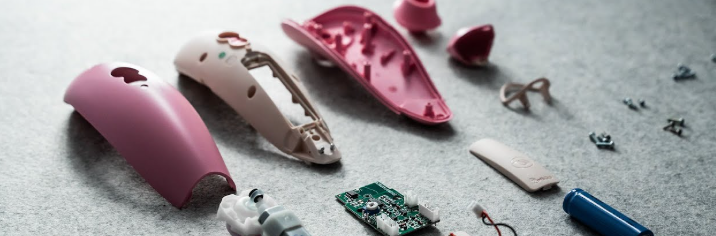
What kinds of parts go into that toy for your parts?
We’ve all had to sadly let go of a vibrator that had lived its life- eventually every single toy croaks, its lifetime elapsed and its vibration no longer functional. But! Have you ever taken one apart before recycling it? What’s even going on in there… and what can you maybe pawn off?
The Vibration Mechanism
Vibration motors are small direct-current (DC) motors with an asymmetrical weight attached to the shaft (eccentric rotating mass, or ERM). Hobbyists, inventors, and robotics enthusiasts buy these in bulk on platforms like eBay. Additionally, inside the small motors is tightly wound, high-purity copper magnet wire, which can be extracted and sold to scrap yards as copper wire or "copper motors" grade scrap.
The Power Source
Here you’ll likely find Lithium-ion (Li-ion) or Lithium-polymer (LiPo) Batteries. Rechargeable models contain pouch or cylindrical lithium batteries (like 18650 cells). If they still hold a charge, they can be resold to electronics hobbyists. If they are dead, specialized e-waste recyclers sometimes pay by weight for lithium batteries due to the cobalt and lithium inside. In battery-operated models, the alkaline battery spring contacts are usually made of nickel-plated steel or brass, which can be collected for scrap metal.
The Circuitry (E-Waste)
The internal control boards (Printed Circuit Boards or “PCB”s) contain small amounts of precious metals (gold flashing on contacts, silver, and copper traces). Scrap yards and e-waste processors buy these by the pound, often classifying them as "Low-Grade" or "Mid-Grade" electronics boards. There are also Microcontrollers and Charging Ports. Components like USB-C or proprietary charging ports, switches, and LED lights can be desoldered and sold as electronic components if you have the tools. Be careful not to inhale too much lead when soldering!
Wiring and Connectors
There will also be more wire than just within the motor, which is the internal insulated wire. The thin wires connecting the battery, board, and motor contain copper. While light, they can absolutely be thrown into an "insulated copper wire" scrap bin.
Casing and Structural Metals
Can’t forget about weight blocks. These tiny weights attached to the motor shafts to cause the vibration are often made of tungsten, brass, or lead because of their high density. Brass and tungsten have distinct scrap values. Finally, there may also be external decorative metals. Premium toys sometimes feature aluminum, zinc alloy, or stainless steel trim/handles that can be separated into clean metal scrap fractions.
So, what’s the breakdown? Can you make big bucks by scrapping and selling your sex toys? Well… no, not really. The total price you could probably get for individual components is $0.00. No scrap yard, electronics recycler, or buyer purchases salvaged micro-motors, used PCBs, or tiny bits of plastic/silicone from a consumer sex toy. Used personal care and intimate products are generally unsellable on secondary markets (eBay, Facebook Marketplace, etc.) due to platform policies and hygienic sanitary concerns, which kind of takes it out of the question whether you could pawn it off on someone else to do the scrapping as well. Instead of trying to part them out for cash, local municipal electronic waste (e-waste) recycling is, of course, the proper way to dispose of them.
That is, unless you’ve got a project that can use any of those components yourself! Any kind of circuit-bending or assemblage project, you might be able to salvage some parts from old faithful.
Happy scrapping!